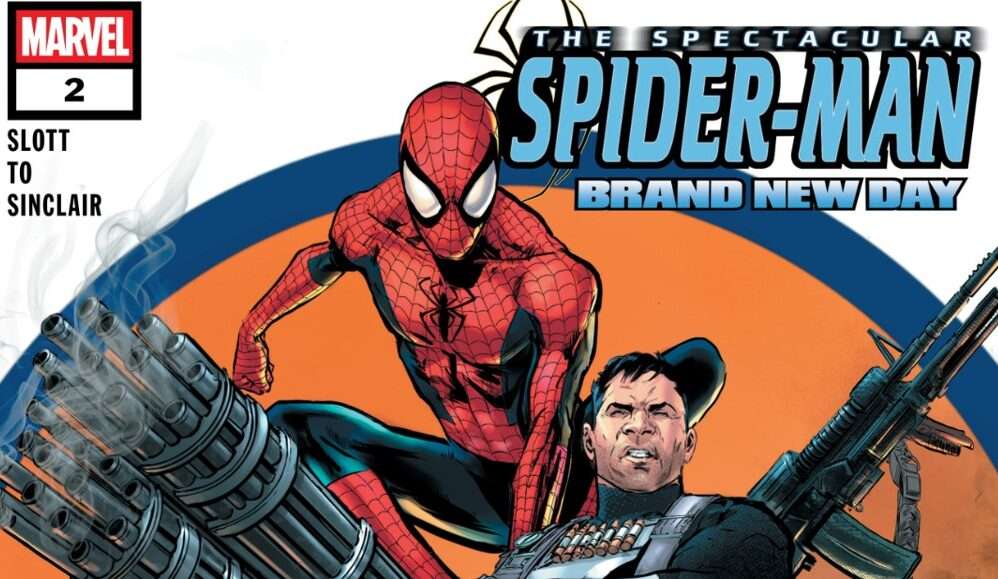
Peter Parker’s Worst Night Shift
There is something very Spider-Man about Peter Parker having to crawl through sewage, stop a mind-controlled Punisher, race across the city, teach a computer class on almost no sleep, and then break into the Daily Bugle before his day is even close to over.
That mixture of superhero chaos and painfully ordinary responsibility is exactly what Spectacular Spider-Man: Brand New Day #2 understands. Dan Slott continues revisiting the “Brand New Day” era without simply replaying familiar beats. Instead, he uses the gaps between previously published stories to show just how exhausting Peter’s life really was—and how much of that exhaustion he hid beneath the jokes.
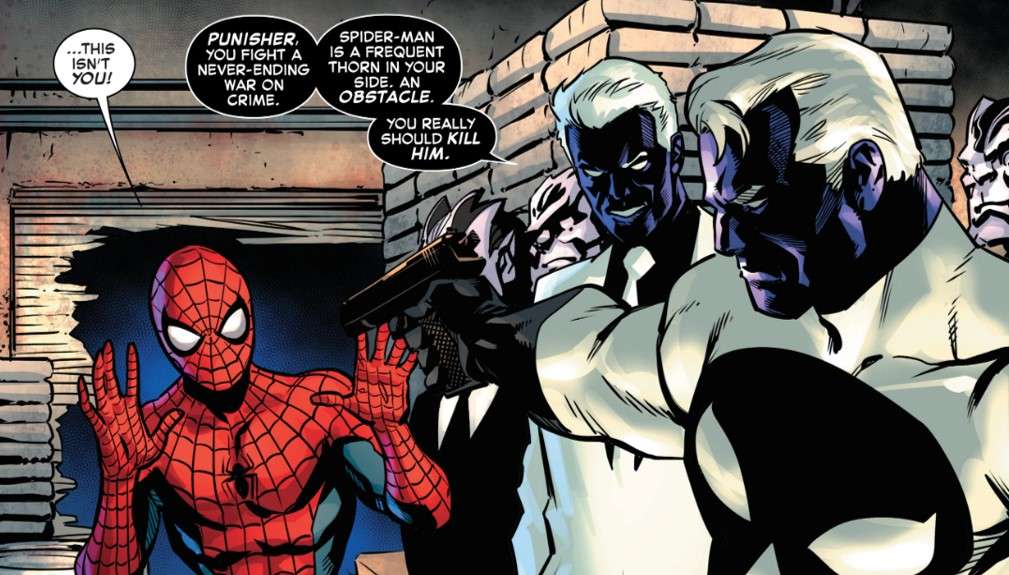
The issue opens in the aftermath of Spider-Man’s disastrous encounter with Frank Castle and Mister Negative. Frank has been corrupted by Mister Negative’s touch, turning the Punisher into a weapon aimed directly at Spider-Man. What follows is loud, frantic, and appropriately messy. Spider-Man is not merely dodging bullets; he is trying to survive an enemy who knows exactly how to make every shot count.

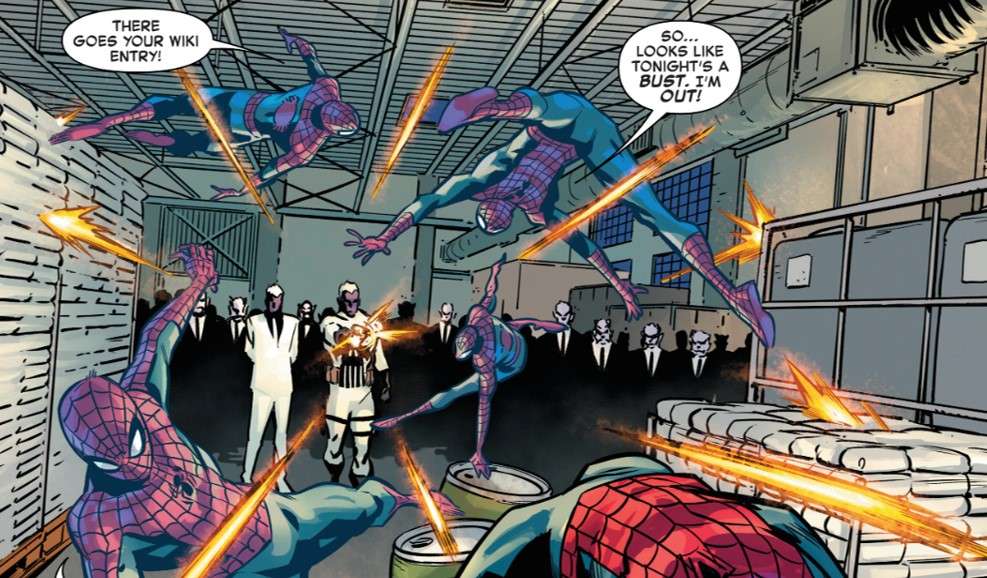
The opening fight works because Frank still feels like Frank even while under someone else’s influence. He is methodical, relentless, and terrifyingly efficient. Spider-Man, meanwhile, never stops talking because talking is part coping mechanism, part strategy, and part Peter simply being Peter. His line about his “wiki entry” disappearing after Frank fires at him is classic Spider-Man humor: funny in the moment, but also carrying the uncomfortable reminder that Peter knows he could die at any second.
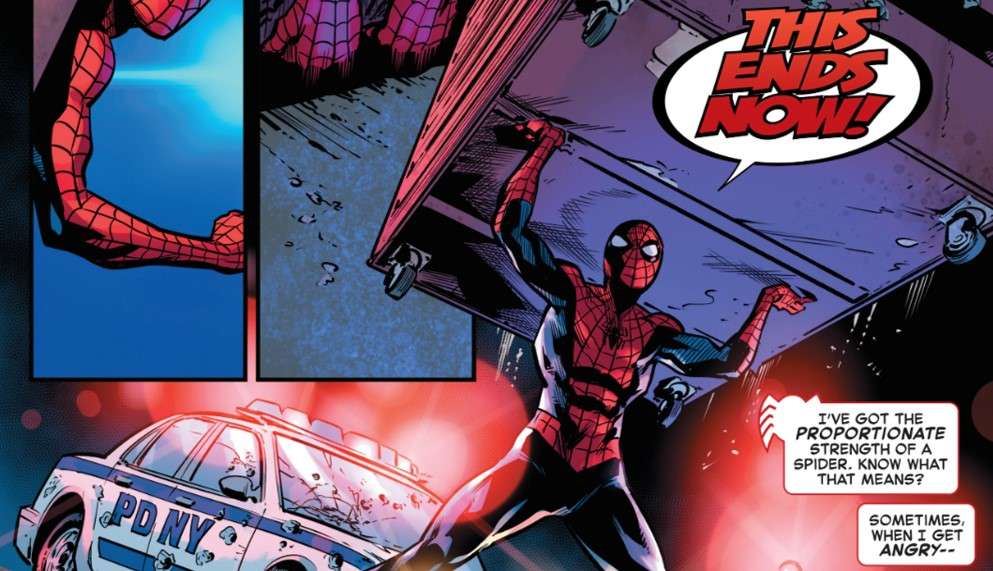
Marcus To’s action is energetic without becoming difficult to follow. The choreography gives Spider-Man room to move like Spider-Man. He twists, flips, redirects gunfire, and uses the environment rather than simply trading blows. The moment in which Peter hoists a police vehicle over his head is especially effective because it communicates how frighteningly strong he can be when pushed. Peter usually restrains himself, but anger and desperation bring out a more forceful side.
That makes his confrontation with the Punisher more than a standard superhero fight. Peter is not just trying to stop Frank. He is trying to reach him.
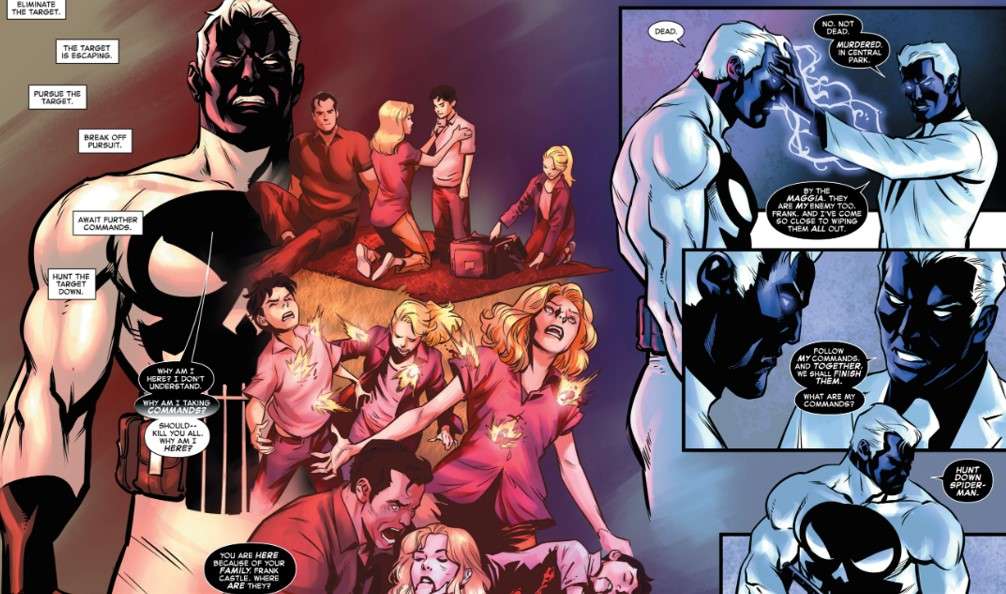
The problem is that Mister Negative has buried Frank beneath layers of pain, memory, and rage. The visual sequences showing Frank’s murdered family are a strong reminder that his entire identity was built around a wound that never healed. Mister Negative does not manufacture Frank’s darkness; he simply takes what was already there and points it in a new direction.
There is an unsettling tragedy in watching Frank receive commands without fully understanding why he is following them. The Punisher is usually defined by his iron certainty. Here, that certainty is hijacked. He believes he is acting with purpose, but he is actually being controlled by someone who sees him as disposable muscle.
Spider-Man eventually manages to escape rather than defeat him, which feels right. Peter is clever enough to survive, but Frank remains dangerous enough that escaping counts as a victory.
The issue then shifts gears dramatically, and this is where it becomes much more than an extended action sequence.
Peter climbs out of the sewer, discovers dozens of missed messages, and realizes he still has obligations waiting for him. Yuri has been hurt. Aunt May is worried. His new teaching job has already started. Peter has been awake all night, smells terrible, and is expected to walk into a room full of people and act like everything is normal.
That is Spider-Man.
The scene at the F.E.A.S.T. Center is genuinely charming. Aunt May is disappointed in Peter, but not cruel. Her frustration comes from knowing that he is capable of more and seeing him arrive late for an opportunity she helped arrange. Peter’s apology feels sincere, but we also understand that he cannot explain where he has been without exposing everything.
His introduction to Donnie Yu gives the issue a lighter rhythm. Donnie’s teasing relationship with his grandfather brings some warmth to the classroom, and the computer lesson offers a refreshingly mundane setting after the violence of the opening pages. Peter is awkward, tired, and completely distracted, yet the scene still shows why teaching suits him. He understands technology, relates naturally to people, and genuinely wants to help.
The humor works particularly well when Peter tries to guide the class toward researching Mister Negative without making it obvious that he desperately needs information. He presents it as an exercise in search techniques, only for the students to keep hitting dead ends. It is a clever reminder that even in a world full of superheroes, not everything can be solved through a quick online search.
Peter’s lack of information leads him to the Daily Bugle, where the issue delivers another strong character beat through Robbie Robertson. Robbie remains one of the most dependable people in Peter’s life. He knows Peter is asking for something unusual, understands that there is probably more to the story, and chooses to help without forcing him to explain.
The existence of the Bugle’s archive—the stories that never made it into print—is an intriguing idea. It fits perfectly within the world of journalism and gives Peter access to information that may not exist anywhere else. Robbie’s warning not to visit the restricted twenty-second floor naturally guarantees that Peter will do exactly that.
This section also highlights one of the issue’s central ideas: information is power.
Mister Negative’s Lexicon records New York’s criminal history. The Daily Bugle possesses unpublished stories. Mister Negative wants access to the Bugle’s files. Peter wants access to both. Everyone is hunting for knowledge, but they intend to use it for very different reasons.
Macy’s hidden workspace gives Peter a temporary advantage. The fact that Mister Negative’s people can watch him through a hacked camera adds tension, especially because Peter is unknowingly providing them with exactly what they need. It is a nice reversal: Peter believes he is investigating Mister Negative, while Mister Negative is using Peter to locate the Bugle’s most valuable secrets.
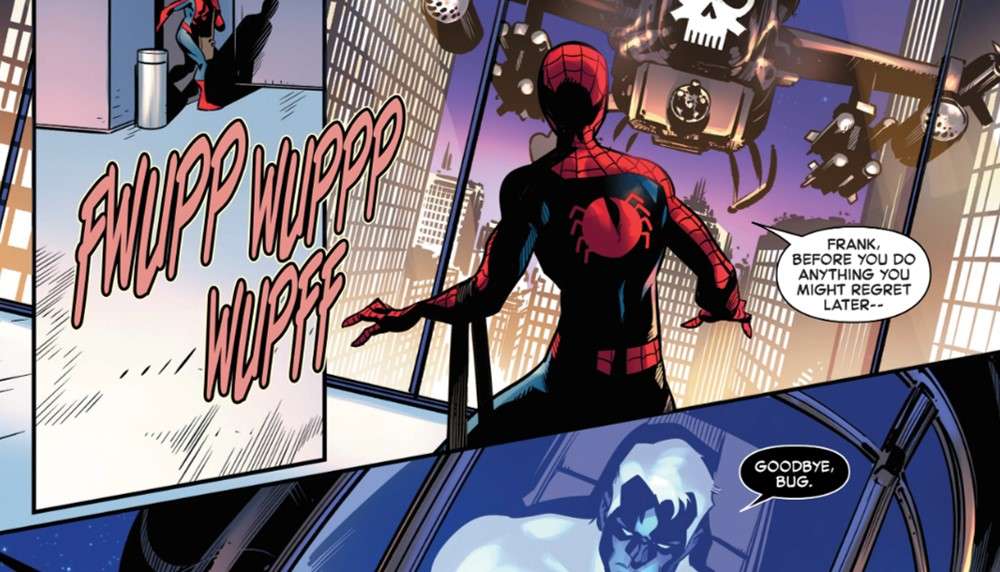
The final appearance of the Punisher in a helicopter is suitably excessive. Frank does not arrive quietly. He arrives by firing rockets into a building because subtlety has never been his defining quality. The cliffhanger works because it brings the issue full circle. Peter spent the entire day trying to escape Frank, only for Frank to find him again at the worst possible moment.
It also leaves Peter facing a difficult problem. He knows Frank is being controlled, which means he cannot simply treat him as an ordinary enemy. Yet Frank is still armed, dangerous, and willing to destroy an entire building to complete his mission. Peter must save himself, protect Macy, preserve the Bugle’s secrets, and somehow free the Punisher without letting anyone die.
No pressure.
PROS
The issue captures the Peter Parker balancing act. The shift from sewer battle to classroom teaching is not a distraction from the superhero story. It is the superhero story. Peter’s real struggle is always the impossible number of lives he is trying to live at once.
Marcus To’s action is clean and dynamic. Spider-Man moves with speed and elasticity, while the Punisher feels heavy, deliberate, and dangerous. Their contrasting styles make the fight visually engaging.
Frank Castle remains recognizable beneath the mind control. Mister Negative’s corruption amplifies Frank’s pain rather than replacing his personality, which gives the conflict emotional weight.
The F.E.A.S.T. Center scenes add heart and humor. Aunt May, Donnie, and the class make Peter’s civilian world feel populated and meaningful.
The mystery expands naturally. The Lexicon, the Daily Bugle archives, and Mister Negative’s growing interest in unpublished information all connect without making the story feel overloaded.
CONS
The issue is juggling several story threads, and the movement between them can feel abrupt. The transition from the Punisher battle to the teaching sequence is thematically appropriate, but it happens so quickly that the emotional aftermath of the fight has little room to breathe.
Mister Negative also remains somewhat removed from the central action. His manipulation is driving everything, but much of the issue is carried by Spider-Man and the Punisher. A little more time with Martin Li or Mister Negative could have strengthened the villain’s presence.
VERDICT
Spectacular Spider-Man: Brand New Day #2 is a busy issue, but that busyness feels intentional. Peter’s life is supposed to feel unmanageable. He is fighting an unstoppable Punisher, worrying about an injured friend, disappointing Aunt May, beginning a new job, investigating Mister Negative, and breaking into the Daily Bugle—all while running on almost no sleep.
Dan Slott understands that Spider-Man stories work best when the superheroics and personal problems are not separate tracks. They collide, interrupt each other, and make every victory more difficult.
Marcus To gives the issue lively, readable action, while the quieter scenes remind us that Peter Parker’s greatest strength is not his ability to lift a police car. It is his refusal to stop showing up, even when he is exhausted, overwhelmed, and completely out of time.
And judging by that final page, Peter’s day is about to get much worse.