One Last Swing Through a Truly Ultimate Era
There is something almost cruelly appropriate about the final Ultimate Spider-Man story beginning with Peter Parker running late.
Not late for a battle against the Maker. Not late for an emergency involving the Sinister Six. Not even late for some grand superhero gathering that will decide the fate of the world.
He is late for a meeting at his daughter’s school.
After two years of watching this older, married Peter Parker learn how to become Spider-Man while balancing his responsibilities as a husband, father, friend, and reluctant revolutionary, this small opening feels like the perfect final statement on what made Jonathan Hickman’s Ultimate Spider-Man so special. The powers were never the point. The costume was never the point. Even the larger war for the Ultimate Universe was never really the point.
The point was Peter trying to be there.
The Spider-Man chapter of Ultimate Universe: Finale #1 does not attempt to top the previous series with a larger battle or another universe-shaking revelation. Instead, it offers something quieter and more fitting: a brief glimpse of life after the war, where Peter and his family are still dealing with problems that cannot be solved by punching a supervillain.
And somehow, that makes this short story feel like a meaningful epilogue to the entire run.
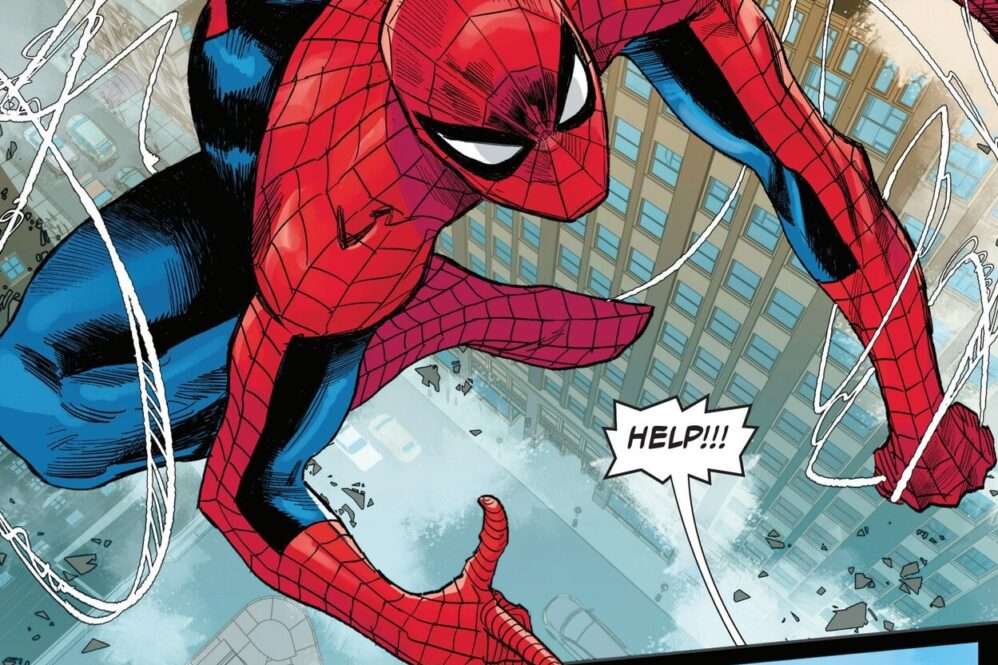
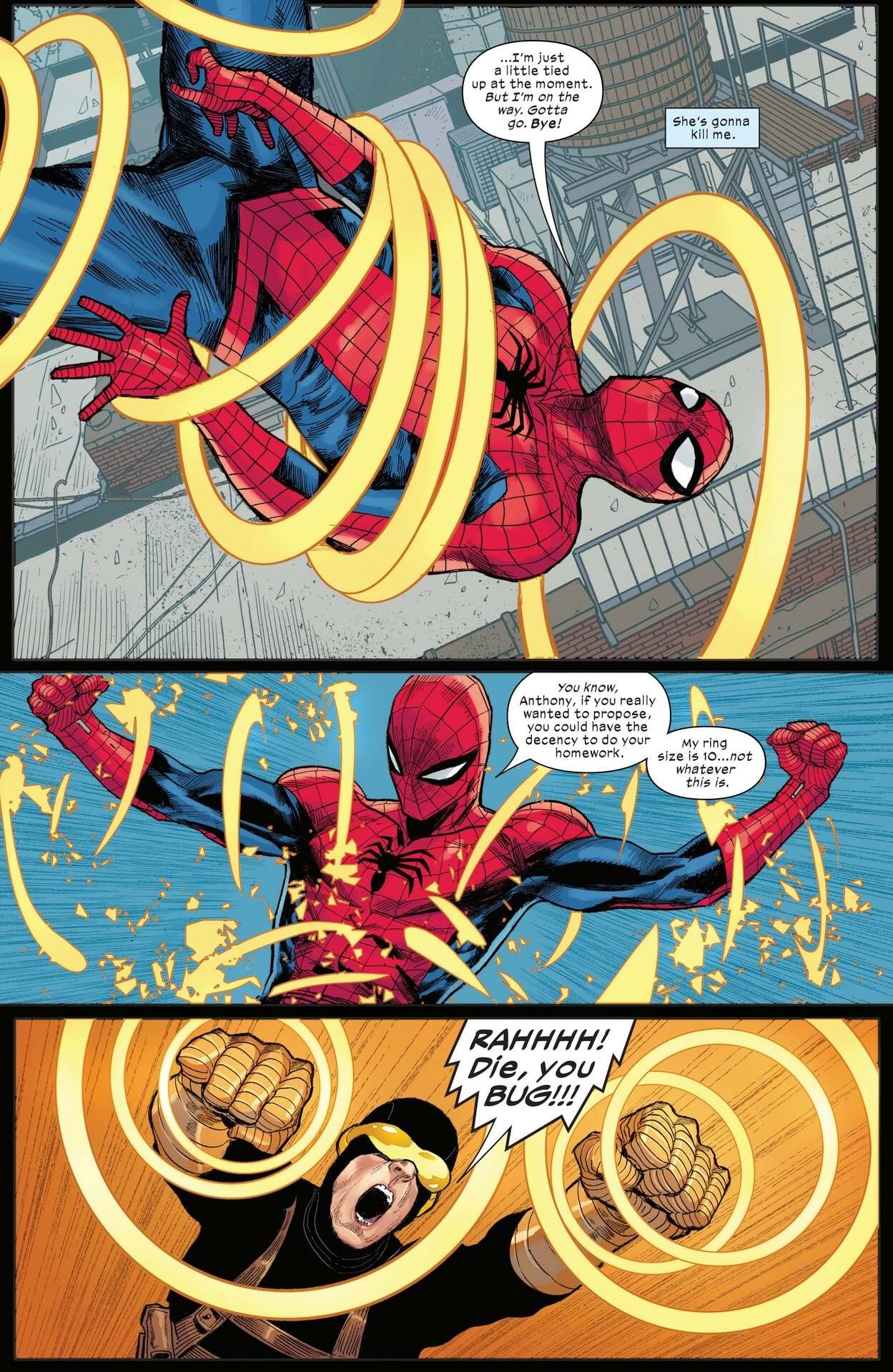
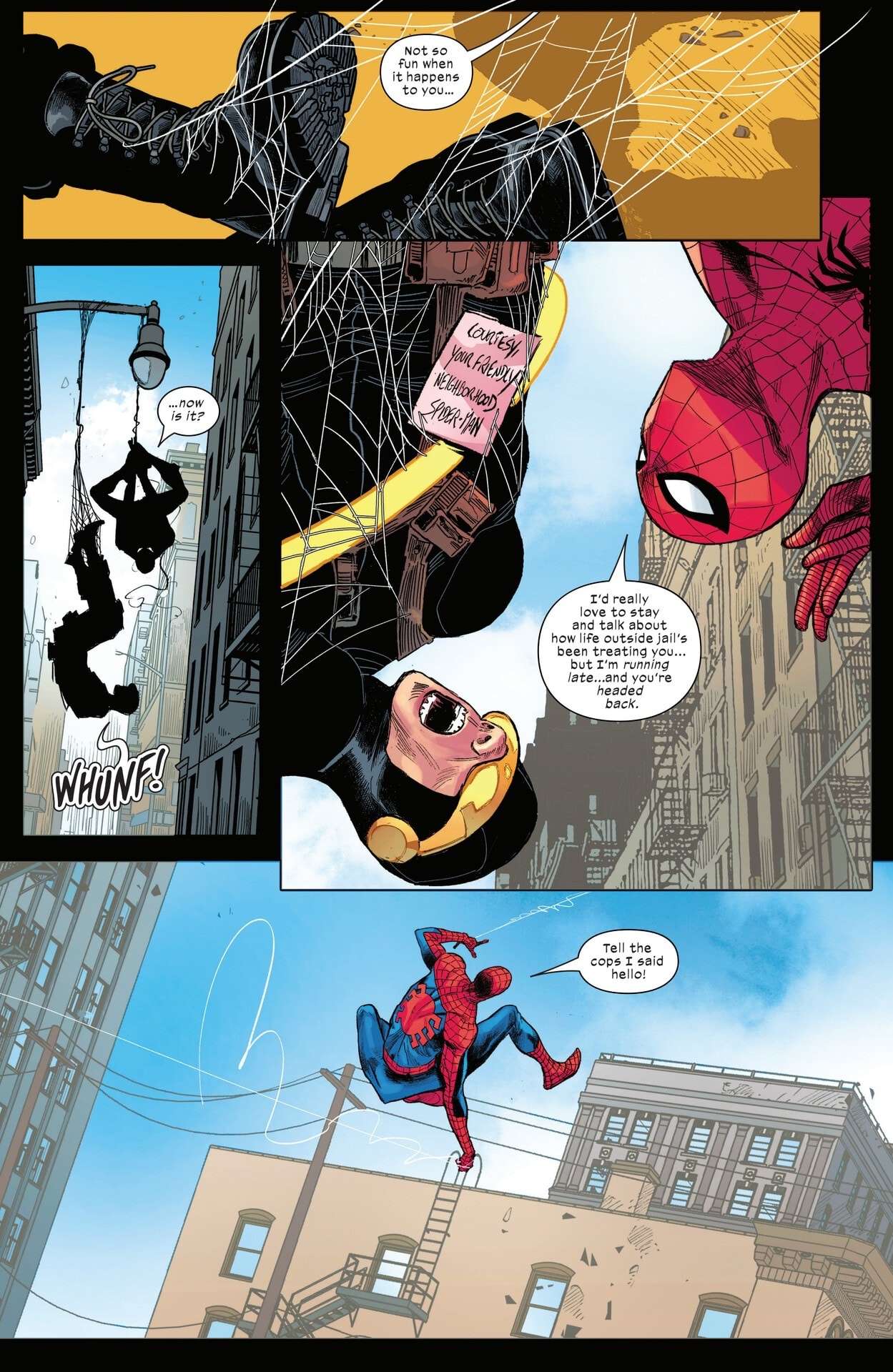
Peter is now openly operating as Spider-Man, apparently with far greater confidence than when he first put on the suit. His encounter with the villain of the week is almost comically effortless. Peter jokes, adapts, and takes control of the situation with the relaxed competence of someone who finally understands the job. The once-hesitant middle-aged man who needed Harry Osborn to guide him through his first missions now moves like someone who has been doing this his entire life.
It is an important contrast to the Peter we met at the beginning of the series.
That Peter had spent decades feeling as though something was missing. The Maker had stolen his destiny before he even knew it existed, leaving him with a vague emptiness he could never properly name. When Tony Stark finally offered him the chance to become the person he was supposed to be, Peter accepted—not because he hated his life, but because he understood that happiness and fulfilment are not always the same thing.
This finale shows us that becoming Spider-Man did fulfil him. Peter is comfortable beneath the mask. He loves the city. He enjoys the ridiculous banter. He even appears to have embraced the familiar chaos of trying to squeeze superheroics between school meetings and family commitments.
But the story also reminds us that gaining one part of yourself does not make the rest of life easier.
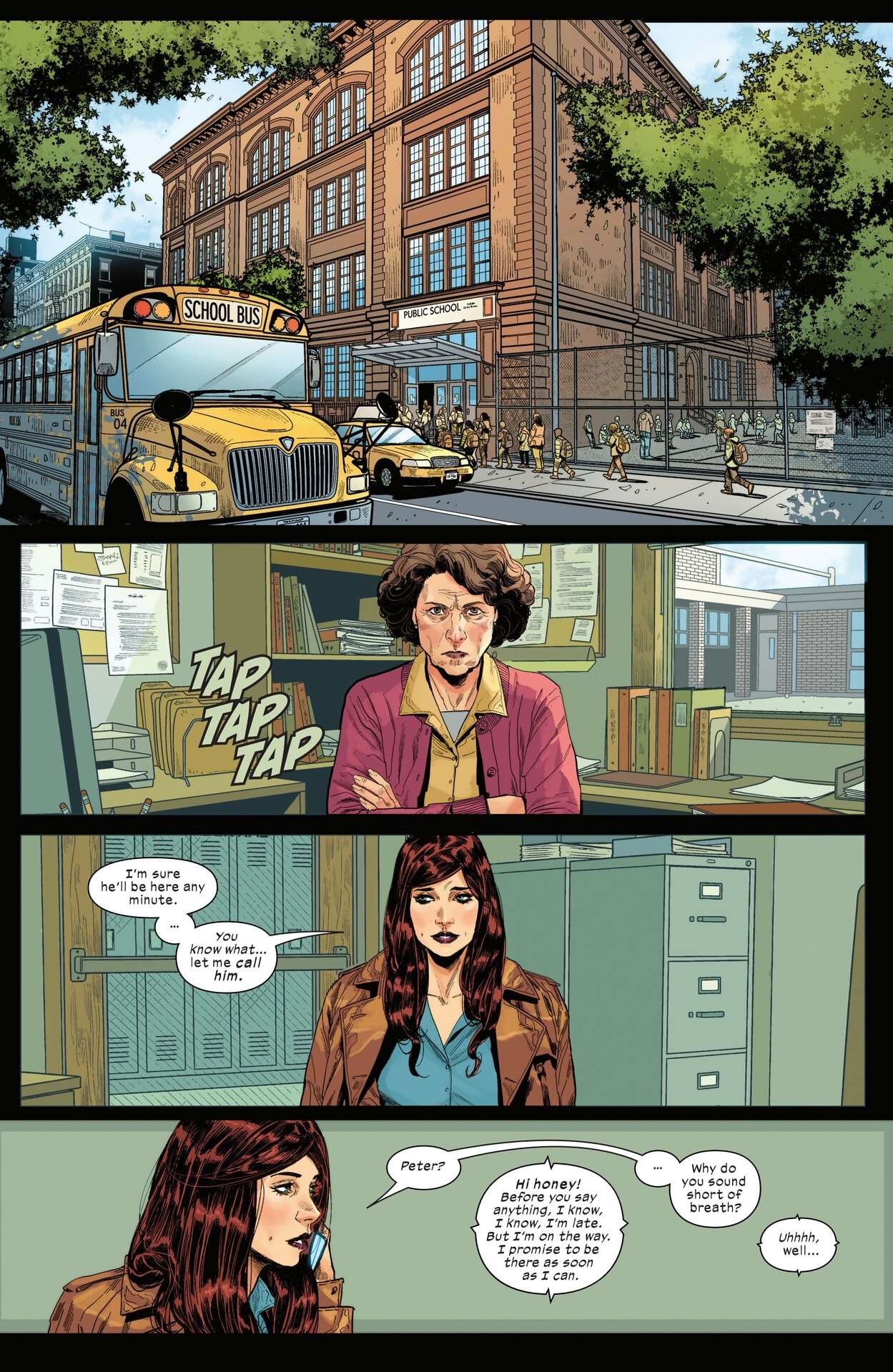
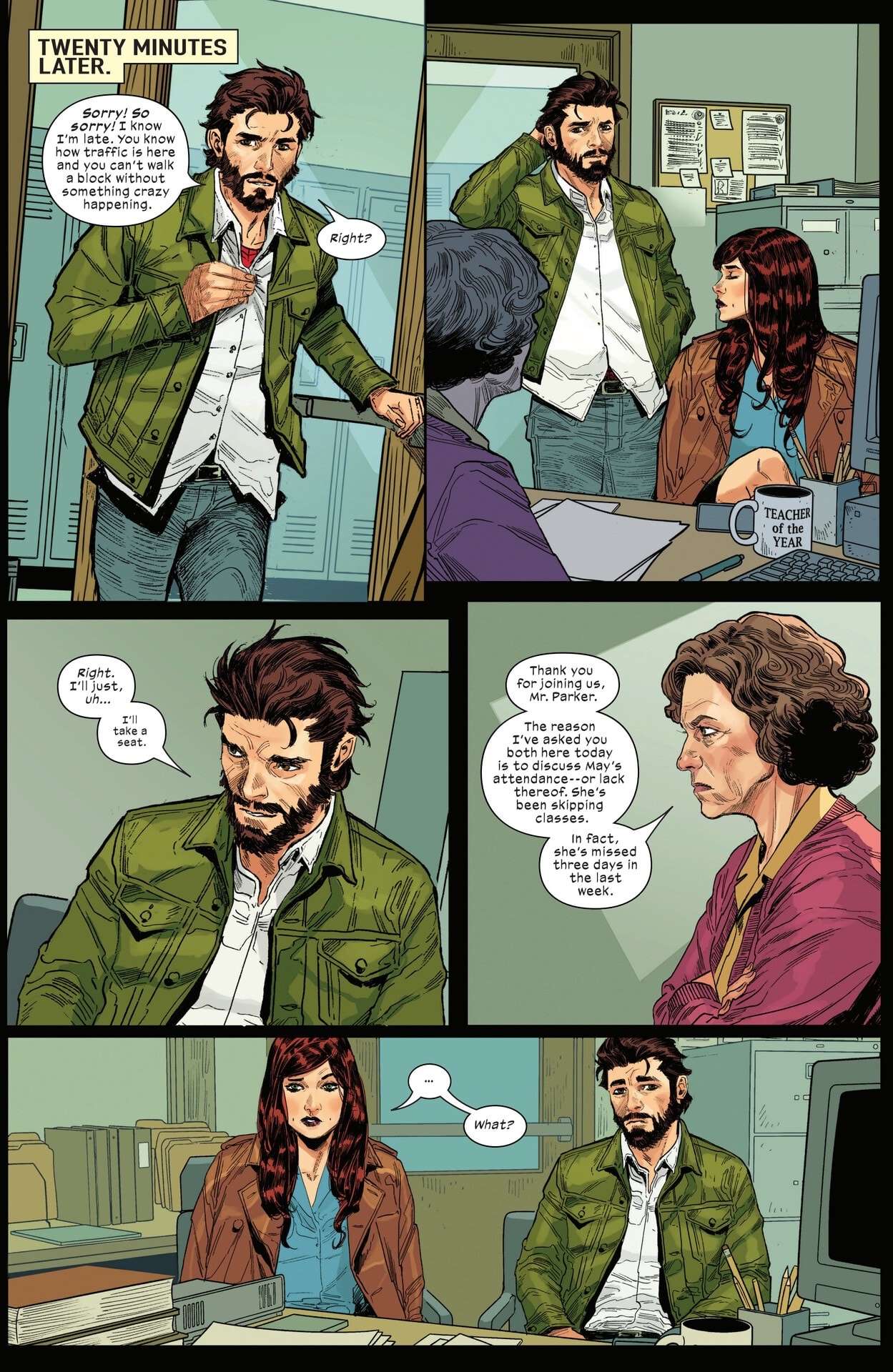
Peter arrives at May’s school alongside MJ, only to learn that their daughter has been skipping classes and disappearing for hours. The conversation is wonderfully mundane on the surface, filled with uncomfortable silences, defensive parental humour, and Peter’s unsuccessful attempts to lower the tension. Yet beneath it sits the central concern that has followed the Parker family throughout this entire series: what happens when the responsibilities of Spider-Man spread beyond Peter himself?
The teacher believes May may be lost.
MJ immediately hears that as an accusation. Peter tries to soften the situation. Neither parent fully understands what their daughter has been doing, and both are forced to confront the possibility that the upheaval in their lives has affected their children more deeply than they realised.
This is where the chapter most effectively connects to the emotional heart of the run. Hickman’s Ultimate Spider-Man was never simply about giving Peter the marriage and family that many readers had long wanted restored. It asked what being Spider-Man would look like when Peter already had those things.
Every decision carried additional weight. Every late arrival meant missing time with MJ, Richard, or May. Every secret created distance inside a family that had previously been secure. Every victory outside the home carried the possibility of creating another problem within it.
The finale does not pretend those tensions vanished when the Maker was defeated.
Peter may have helped save the world, but he still does not know where his daughter goes after school.
That alone makes this ending feel honest.
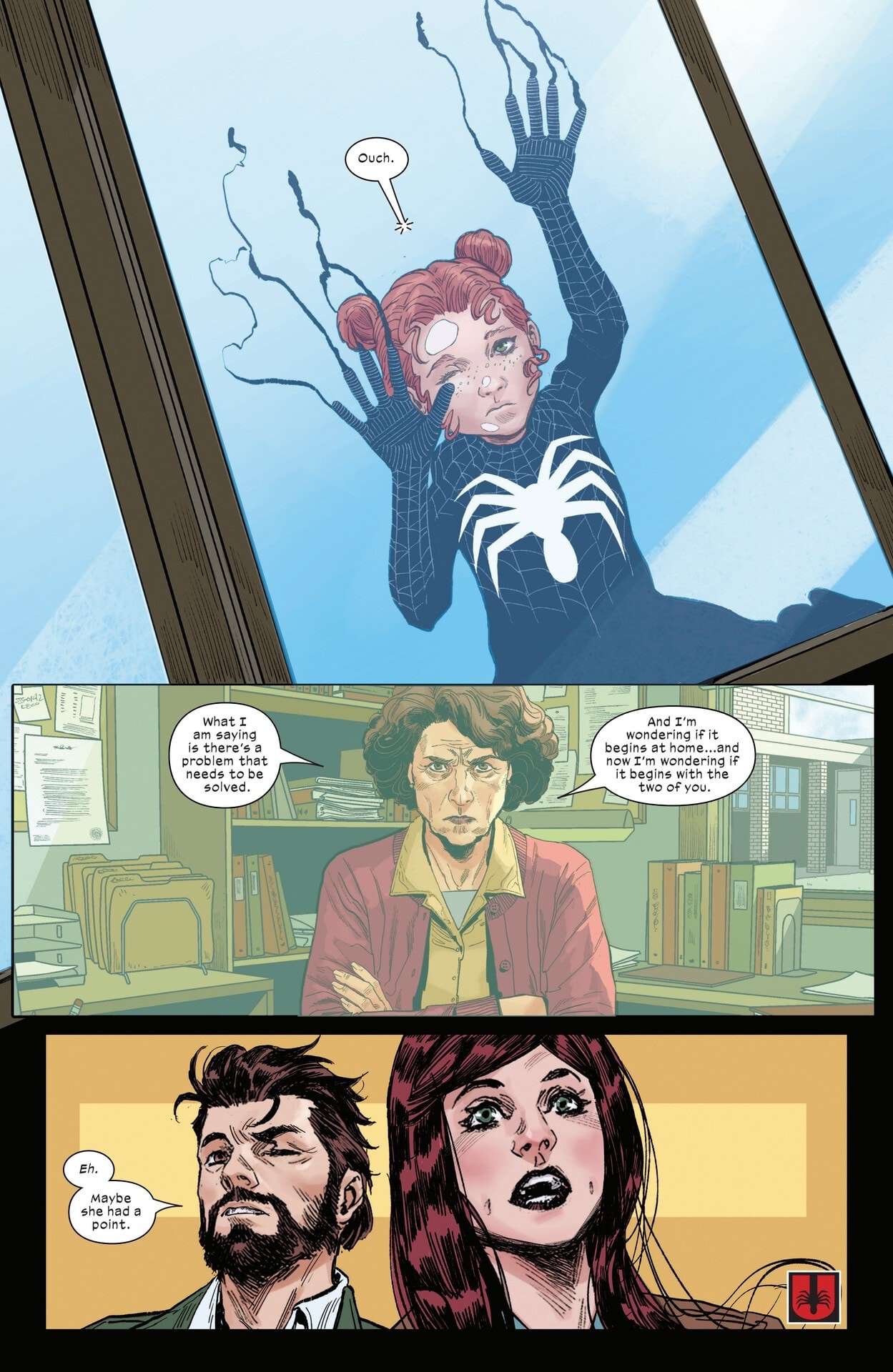
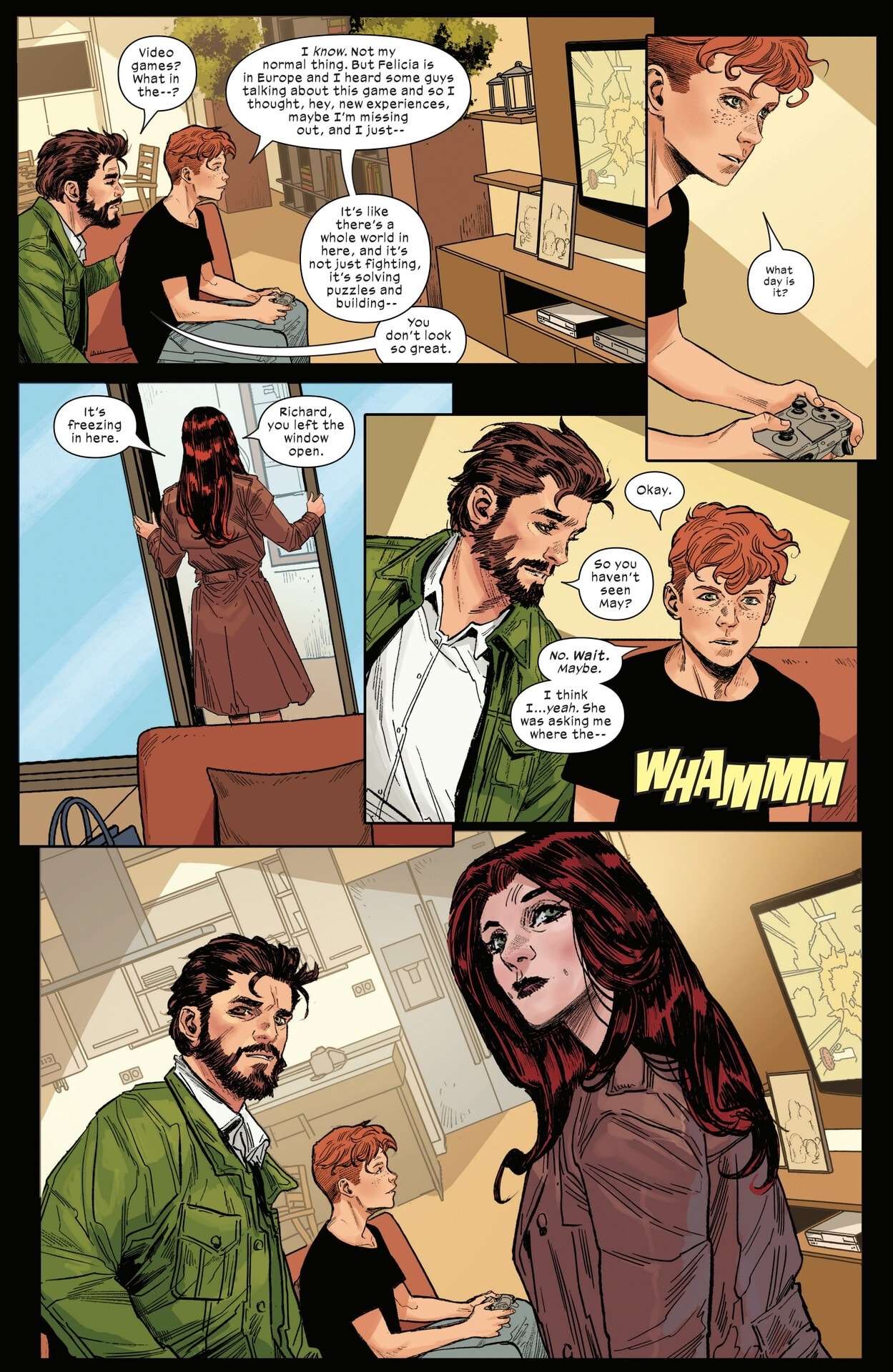
The revelation that May has secretly become a Spider-hero is not especially shocking to readers who followed the series, but it lands beautifully here because of the way the chapter builds toward it. Peter and Richard slowly piece together the obvious clues while MJ unknowingly articulates the truth back at the school. May is not lost. She has found a direction—one inherited from her father, but pursued entirely on her own terms.
Her appearance outside the window, clad in black with a large white spider across her chest, provides the chapter’s biggest emotional payoff. It is funny, triumphant, and slightly terrifying from a parental perspective. Peter’s expression suggests a mixture of pride, resignation, and the painful realisation that he no longer gets to decide whether his children participate in this life.
The responsibility has become generational.
That is a fascinating place to leave this family. Peter spent the series reclaiming a destiny that had been stolen from him. May, by contrast, chooses that destiny for herself. She does not need Tony Stark to hand her powers or explain what she was meant to become. She sees a world that needs help, recognises what she can do, and acts.
It is perhaps the clearest proof that Peter’s world truly has changed.
There is also a lovely visual symmetry in the chapter’s movement between Peter and May. Peter’s early action sequence is bright, playful, and full of movement, while May’s final reveal is softer and almost dreamlike. The artwork captures the comfortable domestic realism that defined much of Ultimate Spider-Man, from Peter’s dishevelled appearance to MJ’s expressions of mounting frustration. The characters feel lived-in rather than posed, allowing the emotional beats to land without excessive narration.
The action sequence provides enough traditional Spider-Man action to keep the chapter lively, but the real strength lies in the smaller moments: MJ waiting in the school office, Peter fumbling through excuses, Richard quietly playing his game before recognising exactly where his sister has gone, and the parents slowly realising that May’s absences may have a very different explanation.
These moments represent what this entire run did best.
For two years, Ultimate Spider-Man gave readers a Peter Parker who was allowed to grow older without becoming emotionally stagnant. He was not presented as a cautionary tale about marriage or responsibility. His family did not make him less adventurous, less funny, or less heroic. They made every choice matter more.
MJ was not merely the concerned wife waiting at home. She was Peter’s partner, emotional centre, and often the person most capable of understanding what he could not express. Richard and May were not simply accessories used to make Peter appear mature. They had their own reactions to his transformation and eventually began defining their places within this strange new family legacy.
Even Uncle Ben was given a different life and relationship with Peter, while Harry Osborn’s tragic friendship with him added another layer to the familiar story of responsibility, sacrifice, and the cost of becoming who you believe you should be.
The series gave us familiar characters while refusing to simply repeat their familiar lives.
That is why this final chapter works despite its brevity. It does not attempt to summarise every relationship or resolve every lingering thread. It simply allows us to spend a little more time with the Parkers after the dust has settled.
Peter is still late.
MJ is still the first person to recognise when something is wrong.
Richard is still more perceptive than his parents realise.
May is still determined to throw herself into danger.
And Spider-Man is still trying to make it all work.
There will inevitably be readers who wish this finale had been longer. The chapter feels less like a definitive conclusion than the opening scene of another story we may never get to read. May’s secret life as a Spider-hero alone could support an entire series, while Peter’s relationship with his increasingly super-powered family remains full of unexplored possibilities.
The absence of a longer goodbye is frustrating precisely because this version of the Parker family became so easy to care about.
Still, perhaps there is something fitting about ending without closing every door.
The final image is not of Peter defeating an enemy or standing triumphantly over a saved world. It is Peter and MJ looking upward as their daughter clings to the school window in costume. They are surprised. Worried. Probably exhausted.
But they are together.
That may be the greatest gift this run gave Spider-Man fans. It reminded us that Peter Parker does not have to lose everything in order to remain heroic. He does not need to be permanently isolated, miserable, or trapped in the same stage of life. Responsibility does not only mean sacrifice. Sometimes, responsibility means building something worth protecting—and accepting that the people you love will eventually make choices of their own.
For two years, Ultimate Spider-Man showed us a Peter Parker who finally got the life he had so often been denied.
He had MJ.
He had his children.
He had Uncle Ben.
He had friends, failures, enemies, victories, and a city that needed him.
Most importantly, he had the chance to become Spider-Man not because tragedy forced the role upon him, but because he consciously chose to do something meaningful with the life he had already built.
This brief finale may not answer every question, but it leaves Peter exactly where he belongs: somewhere between a family obligation and the next person calling for help.
The journey may be over, but the responsibility continues.
And somewhere above New York, another Parker has already started swinging.
PROS
The chapter captures the domestic warmth, humour, and emotional honesty that made the entire Ultimate Spider-Man run stand apart. Peter and MJ still feel like a believable married couple, while their concern over May gives the short story genuine weight.
May’s final reveal works as both a satisfying payoff and a symbol of Peter’s legacy. He reclaimed the destiny that was stolen from him, and now his daughter is choosing that same responsibility for herself.
The artwork balances playful superhero action with expressive family drama. Peter’s casual handling of the villain of the week demonstrates how far he has come, while the quieter school scenes allow each character’s personality to shine.
As an epilogue, the story wisely focuses on the Parkers rather than trying to recreate the scale of the battle against the Maker. It reminds readers that the family—not the wider Ultimate Universe—was always the emotional centre of this title.
CONS
The chapter is extremely short, and several ideas introduced here feel large enough to deserve much more space. May operating independently as a Spider-hero could have been the foundation of another full arc rather than a final-page revelation.
Because the story functions more as a glimpse of the future than a complete conclusion, it leaves the reader with a lingering sense that the series has stopped rather than truly ended. That incompleteness may be intentional, but it also makes saying goodbye considerably harder.
FINAL VERDICT
The Spider-Man chapter of Ultimate Universe: Finale #1 is not a grand farewell. It is something smaller, warmer, and ultimately more appropriate: one final day in the chaotic life of the Parker family.
It gives Peter a little action, a little humour, another missed appointment, and one enormous parenting problem waiting outside a school window. In doing so, it captures exactly what made the past two years so memorable.
This version of Peter Parker did not become Spider-Man because he had nothing left to lose.
He became Spider-Man because he finally understood how much he had to live for.
And that made this run truly Ultimate.